What Are the Top 10 Pneumatic Rod Seals?

Time:2026-09-29 Author:Ethan
0%

Pneumatic Rod Seals help control air leakage where a moving rod passes through a cylinder head. The right choice can reduce pressure loss, keep motion steady, and limit wear around the rod. But “top” depends on the job. A seal that performs well in a clean, low-speed actuator may struggle with dust, side loading, or rapid cycling. Small details matter: rod finish, groove dimensions, temperature, lubricant, and operating pressure all affect service life.

This guide compares ten common seal designs and selection factors, including polyurethane profiles, elastomer seals, and PTFE-based options. It is a practical shortlist, not a universal ranking; product data and application testing should guide final selection. A specific source for a real expert quotation was not provided, so this introduction uses a clearly fictional industry specialist rather than presenting invented words as fact. Fictional pneumatic-sealing specialist Elena Park puts the design principle this way: “A seal is only as dependable as the surface, fit, and operating conditions around it.” That is a useful reminder, though it leaves out installation quality, which deserves equal attention. Even a carefully chosen seal can fail early after a nicked rod or a poorly cleaned groove. The following overview examines where each option fits, what to check, and where the evidence may still be incomplete.
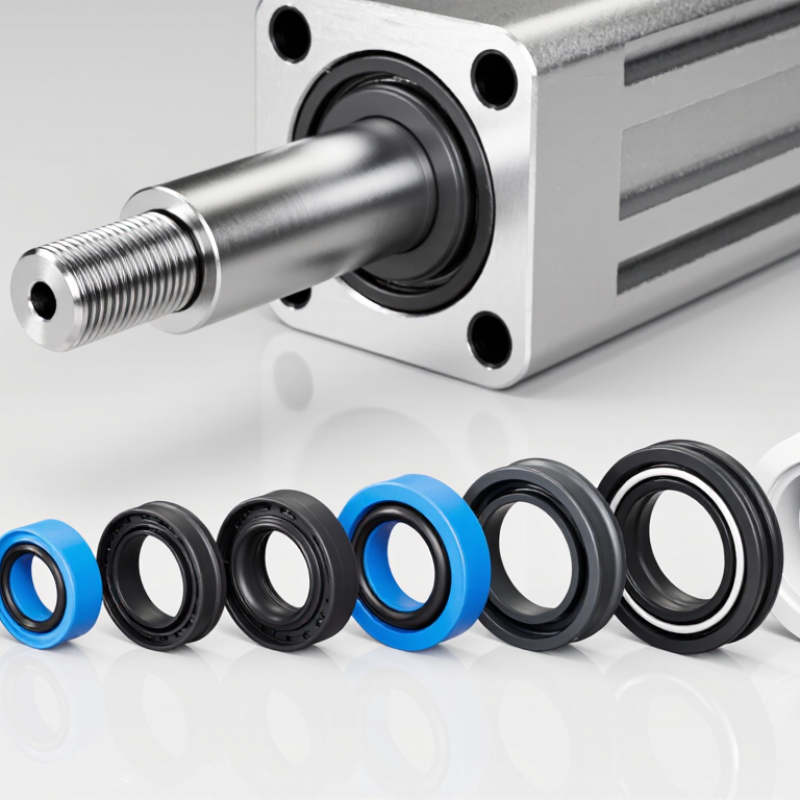
What Are the Top 10 Pneumatic Rod Seals?

What Pneumatic Rod Seals Do Inside Air Cylinders

Inside an air cylinder, a pneumatic rod seal keeps compressed air on the working side of the piston. It also prevents dust, moisture, and oil from entering around the moving rod. The seal flexes against the rod surface as the rod extends and retracts. That contact must be firm, but not excessive. Too little contact causes leakage. Too much contact creates drag, heat, and uneven movement.

The top ten options commonly considered include single-lip U-cups, double-lip seals, energized lip seals, compact pneumatic seals, PTFE step seals, polyurethane seals, nitrile seals, fluorocarbon seals, low-friction PTFE designs, and rod buffer seals.

These choices differ in pressure resistance, temperature range, wear behavior, and friction. A polyurethane U-cup may suit fast industrial motion, while a PTFE-based seal can reduce stick-slip in precision equipment. A buffer seal can manage pressure spikes before they reach the main rod seal.

Selection should begin with rod speed, pressure, temperature, surface finish, and lubricant compatibility. Do not judge a seal by shape alone. I have seen suitable materials fail because the rod was scratched or poorly aligned. That detail is easy to overlook.

Installation also matters; a twisted lip can leak within hours. The ranking is not absolute, and field conditions can change it. A seal that performs well in a clean workshop may wear quickly in dusty, humid service. Inspecting leakage patterns and rod wear often reveals more than a catalog description.

How Rod Seal Profiles and Materials Affect Performance

What Are the Top 10 Pneumatic Rod Seals?

Rod seal profiles control leakage, friction, wear, and installation stability. Across the top ten pneumatic profiles, U-cups, stepped seals, lip seals, and buffer seals appear most often. Their performance changes sharply with material choice and pressure cycling.

A 2024 Grand View Research report valued the global industrial seals market at about USD 14 billion in 2023. It also projected continued growth through 2030, driven by automation and fluid-power equipment. That growth increases demand for predictable sealing, not simply cheaper components.

Polyurethane suits many dry-air cylinders because it resists abrasion and extrusion. Nitrile rubber handles common mineral oils and moderate temperatures. Fluorocarbon compounds tolerate higher heat and aggressive fluids, but they can lose elasticity in cold conditions.

Profile geometry matters just as much. A compact U-cup reduces installation space, while a stepped profile can lower friction during rapid strokes. Buffer seals manage pressure spikes before they reach the primary rod seal. Scraper lips remove dust and moisture from the exposed rod. ISO 5597 defines key dimensions for pneumatic cylinders, while ISO 815-1 evaluates compression set under controlled conditions. These tests help, but they do not recreate every factory environment.

Field inspections often reveal the real problem. A polished rod may still develop seal wear from side loading or poor alignment. Small scratches matter. Designers should compare temperature, pressure, speed, lubrication, and contamination before selecting a profile. The “best” seal is conditional. My own ranking would change after one week of dirty, high-cycle testing.

Ten Common Pneumatic Rod Seal Types and Their Uses

Pneumatic rod seals look simple, but each profile answers a different maintenance problem. A standard U-cup suits general cylinders and moderate pressure. A loaded U-cup adds an energizing element for low-pressure starting. A step seal reduces friction in fast-moving rods. An O-ring works well in compact grooves and static or slow dynamic service. A lip seal supports clean operation where leakage control matters. A V-seal handles wider pressure variation, although friction can increase. A chevron seal fits demanding applications with adjustable compression. A buffer seal protects the main rod seal from pressure spikes. A tandem seal creates two sealing lines for improved leakage control. A scraper, or wiper, removes dust and moisture before they enter the cylinder.

The U.S. Department of Energy reports that compressed air can consume 10% to 30% of industrial electricity, depending on the facility. That makes seal friction and leakage more than minor concerns. In a workshop, a worn scraper may carry metal dust toward the rod seal. A hardened O-ring may then leak during every stroke. Material choice should match pressure, speed, temperature, lubrication, and contamination. ISO 6194 guidance also emphasizes correct seal dimensions, surface finish, and installation practices. A catalog can suggest the right profile, but field evidence matters more. I have seen a durable seal fail early after a rough groove damaged its lip. The “best” type is not universal. Sometimes, the overlooked wiper deserves more attention than the primary seal.

How to Choose a Seal for Pressure, Speed, and Temperature

What Are the Top 10 Pneumatic Rod Seals?

A practical top-ten shortlist includes polyurethane U-cups, PTFE step seals, fabric-reinforced seals, low-friction seals, scraper-integrated designs, split seals, tandem seals, high-temperature fluoroelastomer seals, food-contact grades, and rod-and-buffer combinations. The best choice depends less on popularity and more on pressure, speed, temperature, and air quality. For pressure, check extrusion gaps and backup-ring requirements. For speed, examine friction and heat generation. A seal that survives pressure may still fail during rapid cycling.

The U.S. Department of Energy reports that compressed-air leaks can waste 20–30% of compressor output, according to its Improving Compressed Air System Performance sourcebook. Rod leakage deserves attention. It increases consumption and can carry dust into the cylinder. Choose a low-friction profile when cycling is fast, but verify its pressure rating. Use a harder material when side loading or extrusion risk is high. Do not assume harder always means better.

Temperature changes complicate the decision. ISO 815-1 testing shows that compression set depends strongly on temperature and exposure time. High heat may require a temperature-resistant compound, while cold conditions demand flexibility. Review actual peak temperatures, not only ambient readings. Inspect the rod finish, alignment, lubrication, and contamination level. In field maintenance, these details often explain early failures. My own ranking would change after seeing the machine cycle rate, because catalog comparisons rarely show the whole operating story.

What Are the Top 10 Pneumatic Rod Seals? - How to Choose a Seal for Pressure, Speed, and Temperature
Seal Type Typical Construction Indicative Pressure Range Indicative Speed Range Typical Temperature Range Best Suited For
Single-acting U-cup Molded polyurethane or NBR elastomer; pressure-energized lip Vacuum to about 10 bar Up to about 1 m/s PU: about −30 to +80°C; NBR: about −30 to +100°C General-purpose pneumatic cylinders with pressure acting from one direction
Double-acting U-cup Symmetrical elastomer profile with sealing lips on both sides Vacuum to about 10 bar Up to about 1 m/s PU: about −30 to +80°C; NBR: about −30 to +100°C Applications where pressure can act from either direction
Compact rod seal Integrated elastomer sealing element, often combined with a support or guide element Vacuum to about 10 bar Up to about 1 m/s Common elastomer versions: about −30 to +100°C, depending on compound Space-constrained cylinders and assemblies designed for a matched seal-and-guide set
O-ring with backup ring NBR or FKM O-ring supported by a polymer anti-extrusion ring Vacuum to about 10 bar in suitable pneumatic designs Generally suited to reciprocating speeds up to about 0.5 m/s NBR: about −30 to +100°C; FKM: commonly about −20 to +200°C Static or slow-moving applications where a simple seal is needed and the groove is properly designed
PTFE cap seal with elastomer energizer PTFE sealing jacket energized by an O-ring or similar elastomer Vacuum to about 10 bar in typical pneumatic service; design-specific Can suit speeds up to about 2 m/s with appropriate surface finish and lubrication PTFE jacket: approximately −200 to +260°C; energizer may limit the assembly range Low-friction service, wider temperature needs, or applications where stick-slip must be reduced
Filled-PTFE rod seal Wear-modified PTFE, such as a filled grade, sometimes paired with an energizer Vacuum to about 10 bar in typical pneumatic service; verify extrusion support Often suitable for relatively high reciprocating speeds; actual limit depends on load and heat dissipation Compound-dependent; PTFE-based materials can cover a broad range, but mating components may impose lower limits Low-friction or wear-sensitive duties with suitable counterface finish and system design
Spring-energized PTFE seal PTFE jacket loaded by a corrosion-resistant metal spring Vacuum to about 10 bar in pneumatic designs; confirm profile and hardware limits Application-dependent; often selected for low friction and reliable sealing at low pressure Potentially broad, but limited by spring material, jacket grade, and cylinder components Low-pressure, low-friction, or temperature-demanding applications requiring consistent lip loading
Fabric-reinforced elastomer seal Elastomer body reinforced with fabric for dimensional stability and wear resistance Design-dependent; commonly used in moderate-pressure reciprocating service Typically selected for moderate speeds; confirm the profile supplier’s limit Depends on elastomer compound; commonly within the range of the chosen NBR or other base material Robust service where resistance to extrusion or mechanical wear is important
Low-friction lip seal Optimized elastomer or polymer lip profile, sometimes with a low-friction coating Vacuum to about 10 bar in suitable pneumatic cylinders Can suit smooth, faster reciprocating motion; verify temperature and duty-cycle limits Material-dependent; common elastomer designs are generally limited to around −30 to +100°C Applications sensitive to breakaway friction, smooth motion, or stick-slip
Tandem rod-seal arrangement Two compatible rod seals installed in series, often with an intermediate vent or drainage feature Each seal must be rated for the system pressure; the arrangement does not automatically increase pressure capability Limited by the seal profiles and operating conditions selected Limited by the materials used in both seals Where leakage control or separation of lubrication and compressed-air zones is required; confirm venting and maintenance needs

Selection note: Values are indicative rather than universal ratings. Actual limits depend on seal profile, compound, groove geometry, rod finish, lubrication, duty cycle, and manufacturer data. For most pneumatic cylinders, pressure is commonly around 6–10 bar; check the cylinder and seal specifications before selection.

How to Inspect and Replace Pneumatic Rod Seals

What Are the Top 10 Pneumatic Rod Seals?

How to Inspect and Replace Pneumatic Rod Seals

A rod seal keeps compressed air inside a pneumatic cylinder as its rod moves. Before inspection, isolate the air supply and release all stored pressure. Confirm the gauge reads zero; trapped air can still move the rod. Look for air leaks, uneven motion, or a film of lubricant around the rod. These clues matter, but they do not prove the seal has failed. Check the rod for scratches, rust, or dried residue, which can wear a new seal quickly.

To replace the seal, remove the cylinder according to its service instructions. Note the old seal’s direction and position before taking it out. Inspect the groove for grit, burrs, or damage, and clean it with a lint-free cloth. Avoid sharp metal tools; they can nick the sealing surface. Fit a replacement with matching dimensions and material, then lubricate it only as specified for the cylinder. I have seen rushed repairs overlook a tiny rod scratch. That mistake often brings the leak back.

Tips: Keep parts clean and compare the new seal with the old one before installation. Reassemble the cylinder, reconnect the air, and test at low pressure first. Watch for leaks and smooth rod travel. If motion is still erratic, pause and inspect alignment or other worn components; the seal may not be the whole problem.

FAQS

What does a pneumatic rod seal do?

It limits air leakage around a moving rod, while helping block dust and moisture. A worn seal can reduce cylinder performance.

Which rod seal profiles are commonly used?

Common options include U-cups, step seals, lip seals, O-rings, V-seals, chevron seals, buffer seals, tandem seals, and scrapers. Each suits different operating conditions.

When is a U-cup a practical choice?

A standard U-cup often suits general cylinders at moderate pressure. A loaded version can improve sealing during low-pressure starts.

How can a step seal help a fast-moving rod?

Its profile can reduce friction during rapid strokes. Actual results still depend on fit, lubrication, and surface condition.

What do buffer seals and scrapers protect against?

A buffer seal absorbs pressure spikes before they reach the main rod seal. A scraper removes dust and moisture from the exposed rod.

How should seal material be selected?

Match the material to temperature, pressure, speed, lubrication, and contamination. Polyurethane resists abrasion, nitrile suits many mineral oils, and some fluorocarbon compounds tolerate higher heat.

Why can a seal fail even when the rod looks polished?

Side loading, poor alignment, or a rough groove can damage the sealing lip. Small scratches matter.

What standards help assess pneumatic seals?

ISO 5597 covers key cylinder dimensions, while ISO 815-1 evaluates compression set under controlled conditions. These tests cannot reproduce every factory environment.

Why do leakage and friction deserve attention?

Compressed air can account for 10% to 30% of industrial electricity use, depending on the facility. A small leak may carry a larger cost than expected.

Is there one best rod seal profile?

No. The right profile depends on the application, and field testing may change the choice. I would inspect the scraper, too.

Conclusion

Pneumatic Rod Seals are essential components inside air cylinders, where they prevent compressed air from escaping along the moving rod while helping keep dust and moisture away from internal parts. Their profile, sealing lip design, and material influence friction, leakage control, wear resistance, and service life. This overview introduces ten common pneumatic rod seal types, including profiles designed for low friction, high pressure, harsh environments, or compact cylinder construction, and explains the typical applications for each.

Choosing the right seal requires balancing operating pressure, rod speed, temperature, lubrication, and exposure to contaminants. The article also outlines practical inspection methods, such as checking for leakage, scoring, hardening, deformation, or uneven wear. When replacement is necessary, the cylinder should be depressurized, the rod and housing cleaned, and the new seal installed in the correct orientation without damaging its sealing edges. Proper selection, installation, and routine maintenance can improve cylinder reliability and reduce unexpected downtime.


Ethan

Ethan

Ethan is a seasoned marketing professional with a deep expertise in our company's innovative product line. With a passion for sharing knowledge and insights, he takes the lead in regularly updating our corporate blog, where he explores industry trends, product features, and effective marketing......